
Reviewed 13 October 2026 · RoamDecide Editorial Team
Quick answer: when should you visit Vietnam?
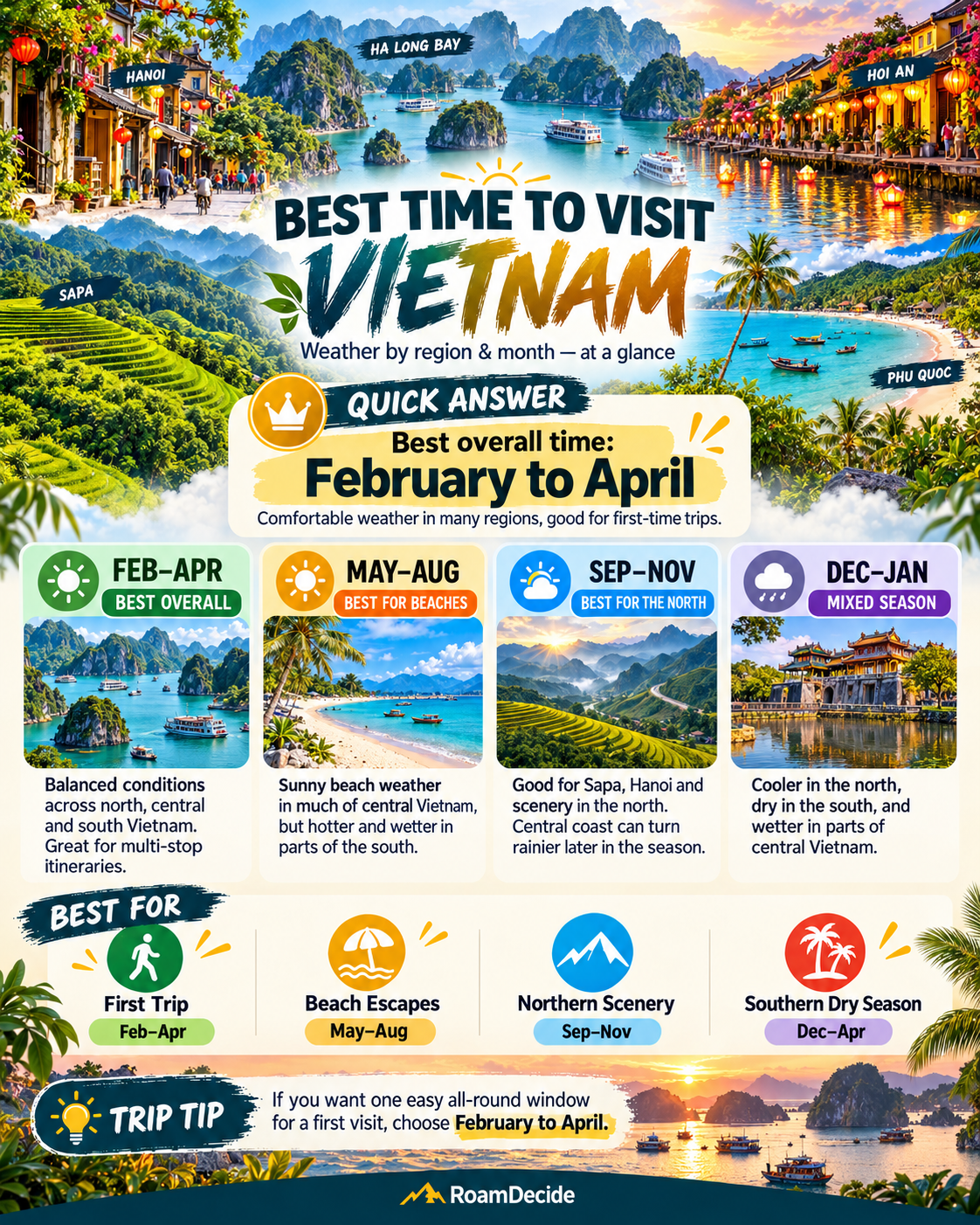
March and April are the best starting point for a first-time trip covering northern, central and southern Vietnam. The north is leaving its damp, misty winter behind, central coastal cities are generally in their sunnier stretch, and Ho Chi Minh City remains in its usual dry season. If you have one destination in mind, choose differently: October–November for Hanoi, February–August for Hoi An and Da Nang, December–April for Ho Chi Minh City, and December–March for beach-focused trips to Phu Quoc. Weather varies even within a season. For a date-specific assessment, read our Vietnam in November 2026: Where to Go and What to Avoid guide, including the latest official seasonal rainfall outlook.
Vietnam weather by region: choose what fits your trip
| Destination | Preferred planning window | When to be more cautious | Decision tip |
|---|---|---|---|
| Hanoi | October–November; April–May | Hot, humid June–August; cool, sometimes misty winter | October–November for comfortable city walks |
| Ha Long Bay | Late March–May; October–November | Cruise changes possible in the tropical-storm season, especially summer; September still carries risk | Leave flexibility around a booked cruise |
| Ninh Binh | Late March–May; October–November | Summer heat and heavy rain; September still carries storm risk | Prioritize outdoor boat and cycling conditions |
| Sa Pa / northern mountains | April–May and September–October | Winter cold or fog; heavy summer rain | Check mountain conditions separately from Hanoi |
| Hue | March–August | September–February is generally wetter | July–August beach weather comes with intense heat |
| Da Nang / Hoi An | February–August | September–November storms and river flooding | March–May balances beach and walking time |
| Nha Trang | January–August | Wetter September–December | Consider summer beach trips, with heat protection |
| Da Lat | December–March for a drier trip | April–November brings more rain | Good alternative to hot cities, but nights can be cool |
| Ho Chi Minh City / Mekong Delta | December–April for drier outings | May–November brings showers and humidity | Morning plans can reduce rain-related disruptions |
| Phu Quoc | December–March for highest-confidence beach planning; November–April broadly favorable | May–October is wetter; October can still be very wet | Don’t sell October as reliably dry for beach holidays |
Why the Phu Quoc caution? Vietnam Tourism describes October–June as generally clear and identifies July–September as stormy. Other destination-specific sources describe a longer wet season extending into October. Because those summaries conflict, RoamDecide recommends the narrower December–March window for travelers whose main purpose is calm-water beach time; November and April are useful alternatives. This is a conservative planning recommendation, not a claim that it rains throughout October.

Vietnam month by month
| Months | Better starting choices | What to consider |
|---|---|---|
| January–February | Southern cities, Phu Quoc; Nha Trang depending on conditions; Hoi An becomes more attractive from February | Hanoi and northern mountains may be chilly; Tet changes transport and opening schedules |
| March–April | Multi-region trips; central coast; northern cities | Increasing heat in the south and late spring |
| May–June | Da Nang, Hoi An, Hue and Nha Trang | Hot temperatures; northern and southern rain becomes more relevant; Ha Long storm risk rises |
| July–August | Central-coast beaches including Da Nang, Hoi An, Hue and Nha Trang | Very hot sun; domestic summer travel; northern storms and southern downpours |
| September | Hanoi and selected northern trips later in the month; flexible city travel | Northern storm risk remains, while central-coast rainfall begins to rise |
| October–November | Hanoi and some northern trips | Avoid treating Hoi An/Hue riverfront trips and Phu Quoc in October as reliably dry |
| December | Ho Chi Minh City, Mekong Delta, Phu Quoc and Da Lat | Northern cities may be cool; central areas including Hoi An can still be rainy; year-end travel demand can increase |

Typhoons and flooding: where a flexible plan matters most
Ha Long Bay and the northern coast
Cruises are weather-dependent. Vietnam Tourism describes June–August as stormy and notes that severe weather can cancel departures. September can still be affected. For a cruise-centred visit, consider late March–May or October–November, then check the operator’s cancellation policy and official warnings near departure. If you only have one free day, compare the shorter option in our Ha Long Bay day trip vs overnight cruise guide.
Hue, Da Nang and Hoi An
These destinations have a different rainfall cycle from the southern beaches. Late-year flooding is a real operational risk rather than a theoretical footnote: Reuters reported that floods in late October 2025 inundated Hoi An’s historic streets and temporarily closed hundreds of businesses, with further high-water warnings in the region in early November. If October or November are your only dates, avoid making a non-refundable riverfront stay or fixed boat activity the centrepiece of your itinerary. Compare the trade-offs in Da Nang vs Hoi An: Where to Stay.

Best time by travel style
- One trip across north, central and south: Start with March–April and allow a little itinerary flexibility.
- Central-coast beaches: March–August can work, with July–August particularly sunny but very hot. Check sea conditions for your exact beach.
- Phu Quoc beach holiday: December–March is the conservative first choice; November and April are alternatives worth checking.
- Hanoi city and food walks: October–November is a strong starting point.
- Sa Pa rice terraces: Consider September to early October for golden fields, recognizing that harvest varies by elevation and year.
- Ha Long cruise: Aim for late March–May or October–November, with weather flexibility whenever you sail.
- Cooler highland break in Da Lat: Consider December–March for relatively drier conditions.
Tet 2027, holidays and crowds
Lunar New Year’s Day (Tet) falls on 6 February 2027. Vietnam’s Ministry of Home Affairs announced a seven-day public-sector break from 4 to 10 February 2027 on 10 October 2026. Private employers may choose among three five-day Tet holiday arrangements around Lunar New Year and must announce their choice in advance; restaurants, shops and other services will not all close or reopen on the same dates. Expect travel pressure around the holiday, changes in small-business opening hours and potential surcharges or reduced availability for transport and accommodation. Plan intercity transfers and essential bookings earlier than usual.
Other times worth watching include the late-April/early-May public holidays, the June–August domestic summer travel period, and Christmas/New Year in major tourist areas. Crowding and price premiums differ by destination; these are seasonal planning signals rather than a comparison of actual hotel rates.
Plan the trip, then the bookings
If you have seven days, choose one region or a compact pairing. With 10–14 days, it becomes more realistic to combine a northern base with central or southern stops. Avoid spending your trip in transit just to see every headline destination.
Continue with Destinations, How to Get Around Vietnam, Where to Stay in Hanoi, Where to Stay in Ho Chi Minh City, or our Mekong Delta guide.

FAQ
Is March or April better for a first trip to Vietnam?
Both are strong candidates. March is generally cooler, while April is warmer and may suit travelers who want more beach time. Your route matters more than a single nationwide average.
Is Vietnam worth visiting in July or August?
Yes, particularly if you prioritize the central coast, including Da Nang, Hoi An, Hue and Nha Trang. Plan for intense heat and domestic holiday crowds; treat mountain roads and northern cruises more cautiously.
Is October a good month for Phu Quoc?
Not the safest choice for a weather-dependent beach holiday. Some travel guides describe October as the start of better conditions, while other regional guides record substantial October rain. For a high-confidence beach trip, prefer December–March.
Can I take a Ha Long Bay cruise during the rainy season?
Sometimes. Operators may sail in suitable weather, but tropical storms can interrupt or cancel departures. Choose flexible terms and follow current official warnings.
Sources, method and limitations
This guide compares destination-specific seasonal descriptions rather than treating Vietnam as one climate zone. Source review: 13 October 2026. Ninh Binh seasonal guidance is an editorial inference from northern regional conditions rather than a Ninh Binh-specific long-term weather series. Sources:
- Vietnam Tourism: Weather and Climate in Vietnam — official tourism overview; publication date not clearly displayed.
- Local Vietnam: Phu Quoc in October — used to flag the discrepancy about October weather.
- Vietnam National Authority of Tourism: Da Lat Climate — longer-term climatic context.
- Tuoi Tre / Reuters: Hoi An flood cleanup, 2 November 2025 — documented late-year flood disruption.
- Vietnam Government Portal: Official Tet 2027 holiday announcement, 10 October 2026.
Data note: Monthly temperature and precipitation normals (°C/°F, mm) are intentionally omitted until a consistent station-based dataset and observation period can be verified across destinations. Climate averages do not predict conditions on a booked departure day; check Vietnam’s official meteorological warnings close to travel. This page has no affiliate booking links.