
Sa Pa is one of northern Vietnam’s most memorable mountain destinations, but choosing the wrong base can turn a scenic trip into a daily transport problem. Should you book near the central square, a hillside hotel overlooking Muong Hoa Valley, or a homestay in Lao Chai or Ta Van? The right answer depends on your trip length, arrival time, plans and tolerance for mountain roads.
Quick Answer: Where Should You Stay in Sapa?
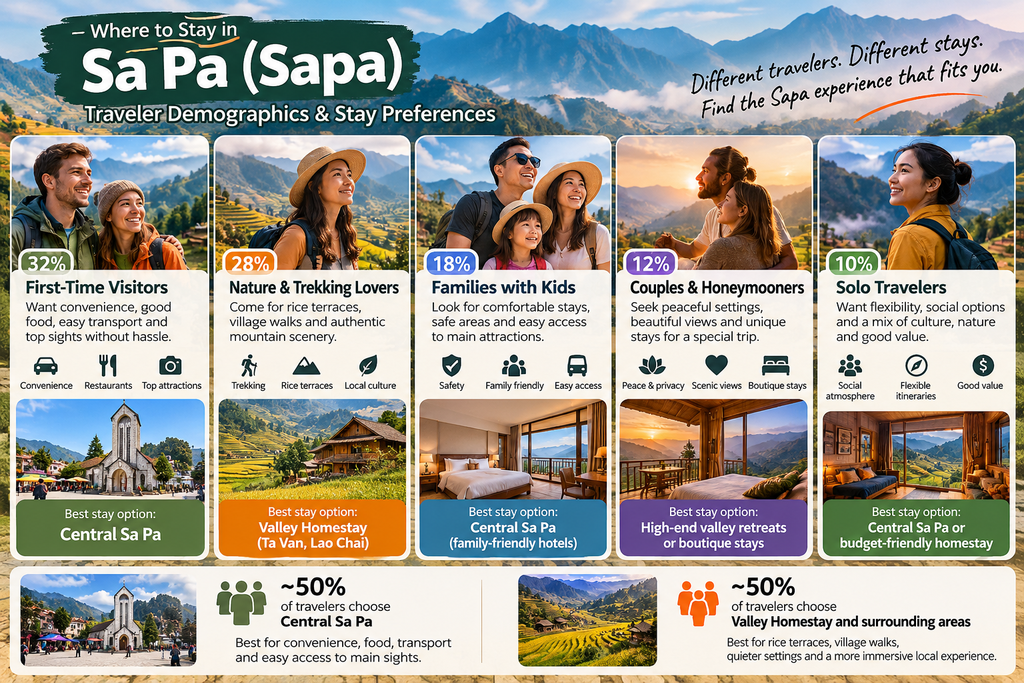
- Central Sa Pa: First visits, one or two nights, restaurants, flexible transfers and Fansipan.
- Town-edge hillside hotels: Hotel comfort and possible mountain views, with steep walks or taxis.
- Muong Hoa Valley: Rice terraces, photography, village trails and quiet mornings.
- Ta Van homestays: Slower stays and possible host interaction, after verifying actual facilities.
- Split stay: Consider for three or more nights if the extra transfer is worthwhile.
RoamDecide recommendation: For most first-time visitors staying two nights, central Sa Pa is the practical default. For trekking and terrace-focused travelers, Lao Chai or Ta Van may fit better.
Sa Pa Accommodation Areas Compared
| Area | Best for | Main advantage | Main trade-off |
|---|---|---|---|
| Central Sa Pa | First-timers, families, short visits | Food, transport and Fansipan access | Noise and room-dependent views |
| Town-edge hillside | Comfort-focused travelers | Hotel facilities and possible views | Steep walks, taxi dependence |
| Cat Cat village edge | Short stays near a village attraction | Near-town village setting | Day visitors and slopes |
| Lao Chai / Muong Hoa | Trekkers and photographers | Terraces and walking routes | Transfers and uneven access |
| Ta Van homestays | Slow travel | Village setting and possible host interaction | Variable comfort and privacy |
| Ta Phin / remote retreats | Seclusion | Quiet setting | More transport and meal planning |
These are area-level recommendations, not rankings of individual hotels. Conditions vary considerably between properties in the same village.
1. Central Sa Pa: Best for First-Time Visitors
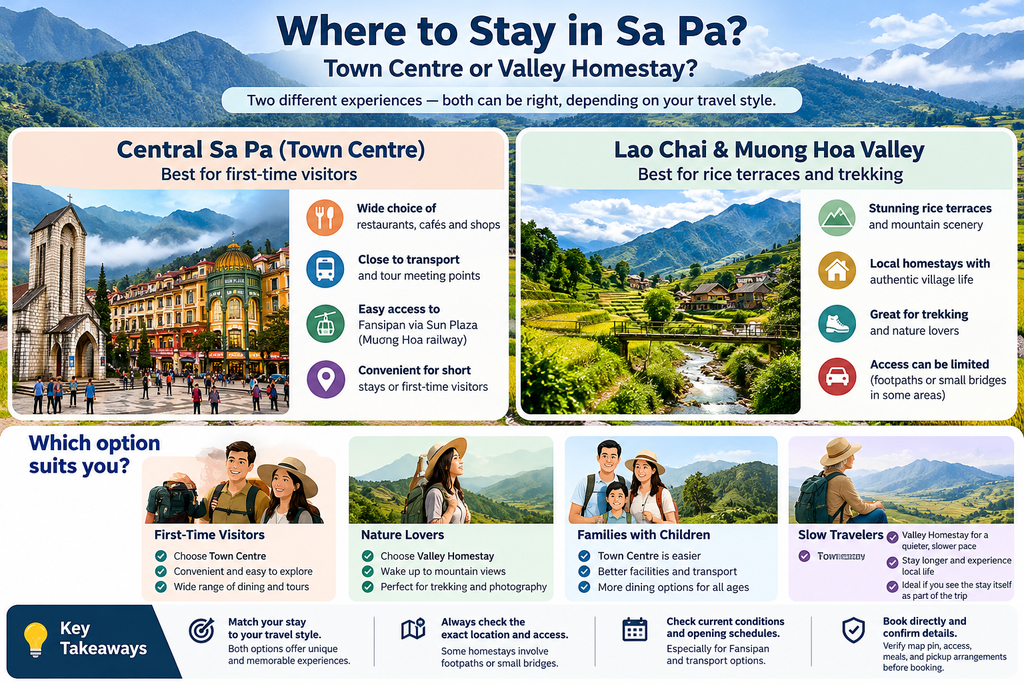
Central Sa Pa is the easiest base for visitors who do not want to arrange a vehicle whenever they leave their accommodation. The area around Sa Pa Stone Church, the central square and Sun Plaza has restaurants, cafés, shops and convenient starting points for sightseeing arrangements.
According to Sun World, the Muong Hoa mountain railway station is at Sun Plaza in central Sa Pa; the railway connects town with the lower station of the Fansipan cable-car system. The railway and cable car are separate stages, and schedules may change.
Who should stay here?
- First-time visitors staying one or two nights.
- Families traveling with children.
- Visitors arriving late or leaving early.
- Travelers planning Fansipan.
- People who want restaurant choices and flexibility in poor weather.
Main trade-offs and booking checks
The centre can be busy on weekends and holidays. A central address does not guarantee a mountain view. Check road noise, the exact walking route, elevators, heating, vehicle drop-off and luggage storage. Decision: Choose the centre when flexibility matters more than sleeping beside the terraces.
2. Town-Edge Hotels: Best for Comfort and Views
Hotels on the slopes outside the busiest streets may combine private bathrooms, heating and breakfast with broader mountain views. Yet Sa Pa’s terrain makes short map distances misleading: a ten-minute walk can include a demanding uphill return.
Best for: Couples and families who want hotel-standard heating and bathrooms with a view, and who are comfortable using taxis rather than walking uphill to the centre.
Verify whether the advertised view belongs to your exact room category, whether a vehicle reaches the entrance and whether the hotel can arrange a taxi. In cold months, a warm, dry room matters more than a dramatic balcony photo.
3. Cat Cat Village Edge: A Near-Town Alternative
Cat Cat is a popular village attraction near Sa Pa town. Staying around its approach can offer a more scenic setting without moving far into Muong Hoa Valley, but day visitors, steep paths and tourist activity can reduce the sense of seclusion.
Best for: Short itineraries combining town sightseeing and a nearby village setting. Check the exact entrance, pedestrian route and vehicle drop-off point. Near Cat Cat is not the same as a remote valley homestay.
4. Lao Chai and Muong Hoa Valley: Best for Rice Terraces and Trekking
Muong Hoa Valley lies below Sa Pa town and is associated with terraced fields, mountain scenery and communities including Lao Chai and Ta Van. The elevation difference matters: walking downhill into the valley may be easier than returning uphill.
Choose Lao Chai when walking routes, landscape photography and quiet mornings are more important than restaurants or spontaneous Fansipan excursions. Plan transport back to town rather than assuming it will be readily available.
The access problem many listings overlook
Some accommodation and walking routes involve footpaths, steps or small pedestrian bridges rather than roads suitable for cars. Access differs from property to property, even within the same village. Ask exactly where a vehicle can stop, whether guests must walk the final section and how luggage reaches the room. This is especially important with large suitcases, children or limited mobility.
Decision: Choose Lao Chai when the landscape and walking experience outweigh the extra transport effort.
5. Ta Van Homestays: Best for Slow Travel
Ta Van is a well-known base for village walks and a slower stay in the Muong Hoa area. Some properties are genuinely family-run, offering shared meals or interaction with hosts. Others operate more like small hotels or guesthouses. Neither is inherently wrong, but the word “homestay” does not guarantee a hosted cultural experience.
Questions to ask a homestay
- Does the host family live on-site?
- Is the bedroom private and is the bathroom private or shared?
- Is reliable hot water and heating available?
- Are breakfast and dinner offered, and at what price?
- Can a car reach the entrance?
- Are walking activities optional, and who organizes and benefits from them?
- What happens if heavy rain prevents the planned walk?
Respect local customs and ask permission before photographing residents or entering private homes. Legitimate accommodation providers generally request identification details for guest registration, including foreign-guest procedures. This alone does not prove legal registration. Avoid sending passport images through unverified messaging accounts.
Decision: Choose Ta Van for a deliberate village stay, not simply because “homestay” sounds more local. Travelers needing step-free access, predictable heating or frequent town visits should check especially carefully.
6. Ta Phin and Remote Retreats: Best for Seclusion
Ta Phin lies outside Muong Hoa Valley, on a separate road from Sa Pa town, so it offers a different type of village stay rather than a convenient base for Muong Hoa Valley treks. Remote properties suit visitors who see the accommodation itself as part of the trip.
Confirm road access, meal availability, pickup, mobile connectivity, heating, hot water and emergency contacts. A quiet mountain retreat may be delightful in clear weather and inconvenient during a cold, wet evening.
Which Sa Pa Area Fits Your Trip?
| Travel scenario | Recommended base | Verify before booking |
|---|---|---|
| One-night or first-time two-night trip | Central Sa Pa | Arrival, heating, walkability |
| Family with children | Central or town-edge hotel | Elevator, stairs, vehicle access |
| Early overnight train or bus arrival | Central Sa Pa | Luggage storage, early check-in |
| Fansipan-focused visit | Central Sa Pa | Railway and cable-car operation |
| Rice-terrace photography | Muong Hoa Valley | Actual room view, field season |
| Trekking priority | Lao Chai or Ta Van | Trail conditions, guide and pickup |
| Hosted village experience | Verified family-run homestay | Host involvement, facilities |
| Three-night mixed itinerary | Town and valley or one base | Transfer time and luggage |
| Limited mobility | Verified accessible hotel | Step-free access, vehicle drop-off |
Decision rule: For one or two nights, prioritize convenience unless trekking is your main purpose. For longer stays, consider the valley if you will have time to enjoy it. For late arrivals, early departures, cold or wet weather, prioritize access and flexibility.
Weather and Rice-Terrace Seasons: Why Your Month Matters
Sa Pa town sits at roughly 1,600 metres, while parts of Muong Hoa Valley are several hundred metres lower. Weather and visibility may differ between locations on the same day. A premium “mountain-view” room cannot guarantee clear skies.
April to October: Wetter conditions
This is broadly the wetter period. Heavy rain can make mountain paths muddy or slippery. For valley stays, pay attention to access roads, flexible cancellation and the host’s ability to arrange vehicle pickup. Do not assume a trail is safe simply because it appears on a digital map.
December to February: Cold-weather comfort
Winter nights can be cold, especially in poorly insulated accommodation. Confirm heating, bedding and hot water. Frost or snow can occur during exceptional cold spells, but neither is a guaranteed attraction.
When are the terraces green or golden?
| Period | Possible landscape |
|---|---|
| Spring to early summer | Water-filled terraces and planting, depending on local schedules |
| Summer | Green rice growth |
| Late September to early October | Golden fields in some areas near harvest |
| After harvest | Cut fields and changing agricultural landscapes |
Planting and harvesting dates vary by elevation, village, weather and year. If the terrace view is your main reason to book, verify current field conditions. See Best Time to Visit Sa Pa.
Trekking Safety: Important for Valley Stays
Mountain village trails should not be treated like city footpaths. During wet weather, consider a knowledgeable local guide, wear grippy shoes, check current conditions, avoid unsafe stream crossings, allow time to turn back, carry a charged phone and offline map, and tell your accommodation your route.
If heavy rain, rising water or local warnings make a route unsafe, change plans. Choose a valley property able to explain how guests can leave safely when walking conditions deteriorate. Avoid depending on a difficult last-minute valley transfer before an early train or bus.
Arriving from Hanoi: Why Arrival Time Matters
Visitors commonly arrive by road from Hanoi or take an overnight train to Lao Cai before transferring onward to Sa Pa. An early-morning arrival may be well before normal hotel check-in. A central hotel offering luggage storage, breakfast or confirmed early check-in can simplify the first day; never assume early check-in is free.
For a valley stay, arrange the transfer from your actual bus stop or Lao Cai connection, confirm whether the vehicle reaches the entrance and whether the host can receive you at that hour. A central hotel is often the simpler default for late arrivals without confirmed pickup. See How to Get Around Vietnam for wider transport planning.
Fansipan: Which Accommodation Base Is Better?
Central Sa Pa is usually more convenient for Fansipan because the Muong Hoa mountain railway begins at Sun Plaza and connects to the cable-car departure area. The railway and cable car are separate stages. From Lao Chai or Ta Van, allow extra time for the transfer to town. Check operating schedules and maintenance announcements with Sun World Fansipan Legend.
Administrative Names and Map Pins After the 2025 Changes
Vietnam reorganized local administrative units in 2025, so some accommodation addresses and older guides may use previous labels. Under National Assembly Standing Committee Resolution 1673/NQ-UBTVQH15 (16 June 2025), central Sa Pa became Sa Pa ward, while much of the Muong Hoa Valley area now falls under Ta Van commune and the Ta Phin area under Ta Phin commune.
Familiar village names such as Sa Pa, Lao Chai, Ta Van, Cat Cat and Ta Phin remain useful for planning but are not necessarily identical to current administrative-unit names. In particular, not every location called “Lao Chai” refers to the Muong Hoa Valley village. Verify the property’s exact map pin, road access and written pickup instructions.
Seven Booking Checks That Matter More Than Star Ratings
- Exact location: Is the map pin at the entrance or only somewhere in the village?
- Vehicle access: Can a taxi reach the building, or is there a steep final walk?
- Heating and hot water: Are they available in your room category and included?
- Bathroom and privacy: Private or shared, and what about noise?
- Actual view: Does your booked room face the terraces or only a shared terrace?
- Total costs: Transfers, meals and activities may change the true cost.
- Cancellation: Can you change plans if severe weather affects your stay?
A cheaper nightly rate does not necessarily mean a cheaper trip once transfers and meals are included.
Suggested Two- and Three-Night Plans
Two nights: First-time visit
Base: Central Sa Pa. Arrive and explore town, then use a day for Fansipan or a guided valley excursion, adjusting the order to the weather. Avoid an unnecessary hotel change.
Two nights: Trekking priority
Base: Lao Chai or Ta Van. Arrange the arrival transfer and spend your main day on suitable village walking routes with local guidance. This works best when the valley is the main purpose of the trip.
Three nights: Town and valley
Option: One night in town and two nights in the valley. Use the town stay for arrival logistics and Fansipan, then move for walking and scenery. Keep a single base if packing and check-in would consume too much time.
Frequently Asked Questions
Is it better to stay in Sa Pa town or Ta Van?
Town is easier for short visits, Fansipan and dining; Ta Van better suits village walks, a slower pace and the surrounding landscape.
Is Lao Chai or Ta Van better for trekking?
Either may work. Choose by the exact property, available routes, guide arrangements and road access, not the village name alone.
Is a homestay always cheaper than a hotel?
No. Compare room standards, meals, transfers and cancellation conditions, not just the nightly price.
Can families stay in valley homestays?
Some are suitable. Verify heating, stairs, railings, bathrooms and vehicle access.
Can I visit Fansipan from a valley homestay?
Yes, with an additional transfer. Check current attraction operating hours and allow enough time.
Can I stay near terraces without trekking?
Yes. Confirm vehicle access and meals if you mainly want a scenic, relaxing stay.
How RoamDecide Makes Recommendations
We compare areas by arrival and transfer friction, access and walkability, weather resilience, accommodation comfort, activity fit and total trip cost beyond the nightly rate. These are destination-research recommendations, not claims of firsthand stays at every property. We do not rank individual hotels without current property-level evidence. This guide has no hotel-booking affiliate links at the time of writing.
Related RoamDecide Guides
- Best Time to Visit Sa Pa (2027)
- How to Choose Where to Stay in Vietnam
- Best Time to Visit Vietnam (2027)
- How to Get Around Vietnam
Sources and Verification
- Lao Cai Tourist Information and Promotion Center — Muong Hoa Valley and Terraced Rice Fields. Destination geography and terrace context (October 2023).
- Sun World Fansipan Legend — Official Website. Operator information about Fansipan access and operating updates.
- Visit Sa Pa — Travel Guide. Supplementary transport context (July 2026); commercial travel website, not an official tourism authority.
- Resolution 1673/NQ-UBTVQH15 (16 June 2025). Legal text concerning commune-level administrative changes.
These sources support destination geography, transport context and general visitor planning. They do not establish individual accommodation prices, room amenities, ownership or current availability. Verify property-specific details directly before booking.
Last researched: 14 October 2026.